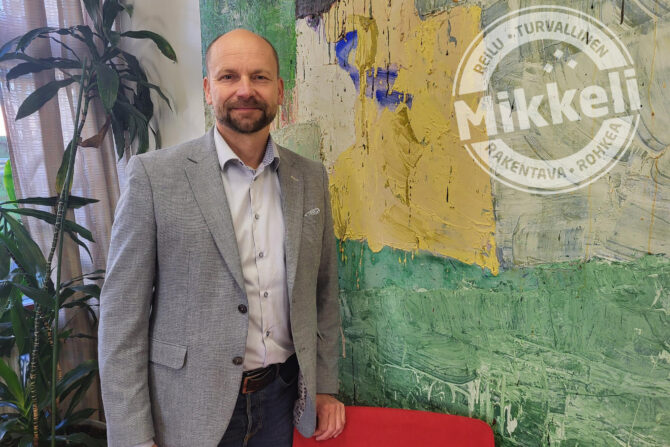
How can services and growth be safeguarded while maintaining a balanced budget? In Mikkeli, the answer lies in investments that strengthen vitality, responsible financial management and the ability to renew.
According to Mayor Janne Kinnunen, Mikkeli’s finances are currently on a stable footing. However, room for manoeuvre remains limited.
”The financial situation is cautiously stable, but our annual operating budget still offers only limited flexibility. Maintaining a balanced economy will continue to require carefully considered decisions and the ability to adapt to change,” says Kinnunen.
In recent years, the city’s financial position has strengthened. The energy asset transaction completed in 2024 significantly improved Mikkeli’s finances, but it does not automatically generate growth.
”Through decisions guided by our strategy, we can safeguard services, invest in the future and strengthen vitality. This means directing resources towards enabling business investments, internationalisation, comprehensive security, and the development of skills and services, among other priorities.”
Growth through investment and the data economy
The preparation of the 2027 budget incorporates the objectives set for the council term. In practice, resources are being directed towards growth and economic vitality.
Mikkeli sees significant opportunities particularly in data centre investments, the security sector and green transition projects. According to Mayor Kinnunen, the key challenge is turning these opportunities into jobs, investment and tax revenue.
”There is considerable potential in Mikkeli at the moment. The challenge is ensuring that investment translates into tangible economic and vitality benefits. These results will not appear overnight, which is why we must look further ahead than just the next year and the next budget cycle.”
Alongside growth, the city must continue to develop the way it operates.
”We will continue to need structural reforms, efficiency improvements and service network decisions to respond to changes in our operating environment and maintain a balanced economy.”
Lower municipal taxation would require a stronger revenue base
Mikkeli aims to create the conditions for a gradual reduction in municipal income tax. City Finance Director Tiia Tamlander emphasises that this is an ambitious objective and would require significant strengthening of the city’s revenue base.
Tamlander points out that even a reduction of just half a percentage point in municipal income tax would reduce annual tax revenues by almost six million euros.
”This is a substantial sum. Now that our operating economy has only recently been brought into balance for the planning period, such a loss of revenue would need to be offset either through new income streams or savings elsewhere.”
For this reason, reducing taxation is closely linked to strengthening local economic vitality.
”Data centre and industrial investments, business growth, improved employment and potential changes to the state funding system could, in the future, create the conditions for lower taxation.”
Tamlander identifies demographic change as the single greatest financial challenge facing the city.
”A declining population, an ageing demographic and a reduction in the number of working-age residents and children represent the most significant long-term threat to the tax base, service structure and overall financial sustainability of the city.”
In addition to demographic trends, uncertainty is created by modest growth in tax revenues and national policy decisions affecting municipal funding.
”Measures aimed at balancing public finances may affect municipalities either through reduced state subsidies or through additional statutory obligations. Both would further limit municipal financial flexibility,” says Tamlander.
Greater impact through new ways of working
Strong finances are not only about balancing income and expenditure. Equally important is ensuring that resources are used effectively and deliver meaningful results. Productivity, service quality and accessibility are becoming increasingly important.
One of the most visible forces of change is artificial intelligence. The City of Mikkeli has gradually begun integrating AI into its operations.
”The city provides opportunities for staff to train in and make use of artificial intelligence in their work. AI can speed up processes, support preparation and free up time for tasks where human expertise is most valuable. However, it is worth remembering that artificial intelligence is a good servant but a poor master,” says Kinnunen.
According to Kinnunen, AI is also closely connected to the broader growth opportunities that Mikkeli is pursuing.
”When we talk about artificial intelligence, we are also talking about the investments that make digital development possible. Without data centres, society would not be able to meet the growing demands of data processing and AI. This is why the data economy, investment and economic vitality are so closely interconnected.”
For both Kinnunen and Tamlander, strong finances are ultimately a means of enabling future development.
“We must simultaneously strengthen economic vitality, expand the tax base and renew the way we operate. The success of these efforts will determine both the quality of services and the opportunities available to Mikkeli in the future,” Kinnunen concludes.